Three Film Festivals Coming to Goleta

Movie lovers get ready – there are three film festival coming to Goleta this fall!

The 2025 NatureTrack Film Festival (NTFF) will take place on October 9 – 10 at Camino Real Cinemas (7040 Marketplace Drive) and the Riviera Theatre in Santa Barbara as an exciting two-day event showcasing world-class films that celebrate nature and outdoor adventure. Following this flagship event, there will be two additional one-day festivals in Santa Barbara and Los Olivos and NTFF will continue the celebration with “On Tour” events throughout the West Coast, bringing inspiring films to even more communities.

NTFF is a celebration of nature and outdoor adventure through film, featuring outstanding works from national and international filmmakers that captivate and inspire audiences. All proceeds from NTFF support NatureTrack and its mission to foster a lifelong fascination with nature and inspire respectful stewardship of our natural world. Celebrate the power of film to inspire, educate, and connect people with nature—both in Santa Barbara and beyond! Learn more at www.naturetrackfilmfestival.org.

The Ceylon International Film Festival (CEYIFF) is taking place October 13 – 17 at Direct Relief Hatch Hall (6100 Wallace Becknell Road). CEYIFF celebrates the vibrant world of South Asian cinema while embracing the creativity of independent filmmakers from around the globe. The festival is dedicated to the art of storytelling, bringing meaningful films to communities and connecting filmmakers with diverse audiences.

CEYIFF is the first-ever Sri Lankan Film Festival Organized outside of Sri Lanka and is dedicated to presenting South Asian and International Independent films to cinema lovers. For more information go to https://ceyiff.com.

The inaugural Wild and Free Film Festival (WAFFF) is a weekend-long event November 14 – 16 at Camino Real Cinemas featuring the screening of over 25 new and original films. It is a bold, independent film festival celebrating adventurous, diverse, and environmentally conscious storytelling from around the world. The festival aims to become a cultural destination event, inspiring audiences through thought-provoking films and community experiences.

The official launch party is happening Saturday, October 18 at Elings Park with an outdoor screening of “The Goonies.” Learn more about the Wild and Free Film Festival and buy tickets to the launch party at www.wildandfreefilm.org

New Data Tool to Track Housing Trends and Challenges

Interactive dashboard offers one-stop access to housing, workforce, and demographic data

Housing, workforce, and demographic trends remain top concerns in Santa Barbara County. A new public Housing Data Dashboard gives residents and community leaders a clearer way to track them.

The Santa Barbara County Association of Governments (SBCAG) developed the dashboard to bring complex information into one place. It shows where housing is being built, how affordable it is, who lives in the region, and how people commute to work. It also provides information on homelessness trends and workforce characteristics.

“Instead of searching through multiple state and federal reports, the dashboard makes annual housing and demographic data easy to access in one place,” said Mia Lewis, transportation planner for SBCAG. “The transparency of the information is helpful for residents and decision-makers working on housing solutions.”

The Housing Data Dashboard originated as a project of the League of Women Voters of Santa Barbara. SBCAG expanded it to a countywide scale and will oversee its long-term maintenance.

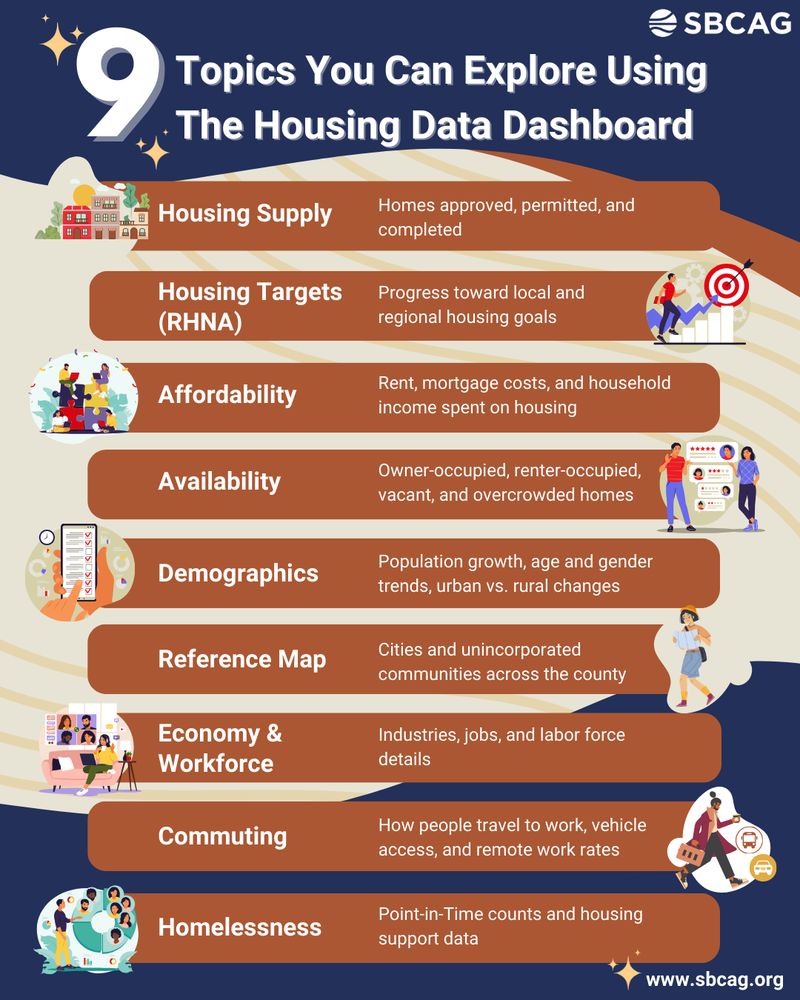
Accessible on SBCAG’s website, the dashboard offers interactive charts, maps, and downloadable workbooks that allow users to filter by city, unincorporated community, or by North and South County. It covers nine main areas called “sections:”

  1. Housing, Supply Production & Type – shows how many homes are approved, permitted, and completed.
  2. Regional Targets for Housing Growth/Regional Housing Needs Allocation (RHNA) – tracks how much housing each city and community has planned and built, with progress shown for the 5th cycle (2014–2022) and 6th cycle (2023–2031) by income level.
  3. Housing Affordability – provides data on rents, mortgage costs, and how much of their income households spend on housing.
  4. Housing Availability & Tenure – shows whether homes are owner- or renter-occupied, vacant, or overcrowded.
  5. General Demographics – tracks population changes, age and gender breakdowns, and urban versus rural growth.
  6. Reference Map – provides a map of cities and unincorporated communities to help navigate the dashboard.
  7. Regional Economy & Workforce – shows where people work, industry types, and labor force details.
  8. Commuting – provides information on how people travel to work within the county, vehicle access, and remote work trends.
  9. Homelessness – tracks annual Point-in-Time counts and information on housing programs and interventions.

A User Guide and Glossary are also provided to support use of the dashboard. A recorded “how-to” video is also available on SBCAG’s YouTube channel to guide users through the dashboard’s features.

“The dashboard is designed for anyone to use, not just data experts,” Lewis said. “We wanted to make it easy to navigate while still providing the depth of information that agencies and community partners need.”

The data comes from trusted sources including the California Department of Housing and Community Development, the U.S. Census Bureau, the U.S. Department of Housing and Urban Development, and local homelessness counts. SBCAG also conducted its own calculations to align data with local planning needs.

The dashboard is updated twice a year. By the end of each calendar year, SBCAG incorporates the prior year’s housing and affordability data released by the California Department of Housing and Community Development. In the spring, the tool is refreshed with the latest demographic and workforce data from the U.S. Census Bureau.

The State Department of Finance designates SBCAG to serve as the affiliate U.S. Census center for Santa Barbara County. As such, SBCAG serves as a conduit for government and public access to U.S. Census data. 

The public can explore the Housing Data Dashboard by visiting the Demographics & RHNA page under Planning & Programming at www.sbcag.org or request a link by emailing info@sbcag.org or calling (805) 600-4477.

Rail Safety Month

As California continues to have the highest number of rail-related fatalities in the United States due to highway-rail grade crossing and trespassing incidents*, Amtrak® Pacific Surfliner® is recognizing Rail Safety Month in September as a time to support safety in rail-adjacent communities.

In this effort, the Los Angeles – San Diego – San Luis Obispo (LOSSAN) Rail Corridor Agency, which manages the Amtrak Pacific Surfliner service, is partnering with California Operation Lifesaver (CAOL), a non-profit entity that works year-round to spread awareness about the importance of safety around train tracks.

“Keeping people safe is an important priority for the Pacific Surfliner,” said Fred Jung, Chair of the LOSSAN Agency Board of Directors. “We are proud to partner with California Operation Lifesaver to raise awareness and provide information on staying safe near train tracks for our Southern California community.”

As the LOSSAN Corridor is the second busiest intercity rail corridor in the United States, supporting commuter, regional and intercity rail service collectively to 41 stations and nearly 4.5 million annual passengers (Amtrak, Coaster and Metrolink), the LOSSAN Agency continues to explore ways to inform riders and the public on how to stay safe.

Follow simple safety rules whenever around train tracks, including:

  • Never walk on or along train tracks; it’s illegal and trespassing is highly dangerous.
  • Cross train tracks only at designated pedestrian or roadway crossings and obey all warning signs and signals.
  • Stay alert around tracks. Don’t do anything that would prevent you from hearing an approaching train, such as listening to headphones or talking on the phone.
  • When boarding, remember to stay behind the marked safety line on the station platform and use handholds as you board.
  • Report suspicious items, persons or activity immediately to the Amtrak Police Department by approaching a uniformed officer, calling (800) 331-0008, sending a text to APD11 (27311) or calling 911.

The partnership between the LOSSAN Rail Corridor Agency and CAOL will deliver rail safety advertisements across social media, websites and connected television platforms to people who live and travel near the corridor. Using location-based targeting informed by recent data on trespasser fatalities and near misses, the month-long campaign will run from September 1–30 and provide safety tips tailored to local audiences.

Additionally, the LOSSAN Agency is collaborating with officials in the Tri Counties (San Luis Obispo, Santa Barbara and Ventura) to post safety signage in high traffic areas and schools adjacent to the train tracks.

Digital tools are available at PacificSurfliner.com/RailSafety, including activities for kids, lesson plans for teachers and parents and downloadable presentations developed by Operation Lifesaver and CAOL, two non-profit entities that work year-round to promote rail safety.

For more information on Rail Safety Month:

*According to CAOL and the Federal Railroad Administration.